

Where Innovation Meets Digital Excellence! Tagscripts Digital Transforming businesses with cutting-edge SEO, PPC, and social media performance mastery by data-driven strategies and personalized solutions tailored just for you.

ROAS vs CPA vs CAC: Which Metric Actually Matters?

Tagscripts
October 16, 2026
ROAS vs CPA vs CAC: Which Metric Actually Matters?
Running digital advertising campaigns involves more than tracking clicks, impressions, and website traffic. To understand whether your marketing efforts are generating business value, you need to measure the right performance metrics.
Three commonly used metrics are ROAS (Return on Ad Spend), CPA (Cost Per Acquisition or Action), and CAC (Customer Acquisition Cost). Although they are related, each measures a different aspect of marketing performance.
Understanding ROAS vs CPA vs CAC helps businesses evaluate advertising profitability, control acquisition costs, and make smarter decisions about marketing budgets.
But which metric actually matters most? The answer depends on your business model, campaign objective, and growth stage.
1. What Is ROAS (Return on Ad Spend)?
ROAS measures the revenue generated for every unit of money spent on advertising. It helps businesses understand how effectively their advertising budget generates revenue.
ROAS Formula
ROAS = Revenue Attributed to Ads ÷ Advertising Spend
For example, if you spend ₹20,000 on Google Ads and generate ₹1,00,000 in attributed revenue:
ROAS = ₹1,00,000 ÷ ₹20,000 = 5
Your ROAS is 5x, meaning the campaign generated ₹5 in attributed revenue for every ₹1 spent on advertising.
When Should You Track ROAS?
ROAS is particularly useful for:
• E-commerce businesses
• Online product sales
• Performance marketing campaigns
• Businesses tracking advertising-attributed revenue
However, ROAS does not account for product costs, salaries, shipping, or other operating expenses. A high ROAS does not automatically mean your business is profitable.
2. What Is CPA (Cost Per Acquisition or Action)?
CPA measures how much you spend to generate a specific action through your marketing campaign. Depending on how a business defines its conversion goal, this action could be a lead, registration, purchase, or enquiry.
CPA Formula
CPA = Advertising Spend ÷ Number of Conversions
For example, if your campaign spends ₹15,000 and generates 75 leads:
CPA = ₹15,000 ÷ 75 = ₹200
Your cost per lead is ₹200.
When Should You Track CPA?
CPA is useful when your campaign aims to generate measurable actions, including:
• Form submissions
• Consultation bookings
• App registrations
• Product purchases
• Qualified enquiries
One important distinction is that a low CPA does not necessarily indicate success. If your campaign generates many low-quality leads that never become customers, the apparent efficiency may not translate into business growth.
For this reason, businesses should distinguish between cost per lead, cost per qualified lead, and cost per paying customer.
3. What Is CAC (Customer Acquisition Cost)?
CAC measures the cost of acquiring a new paying customer. Unlike a campaign-level CPA, CAC can include a broader range of sales and marketing expenses.
Depending on your measurement approach, these costs may include advertising, agency fees, marketing tools, sales salaries, and other acquisition-related expenses.
CAC Formula
CAC = Total Sales and Marketing Acquisition Costs ÷ Number of New Customers Acquired
For example, if a business spends ₹60,000 on sales and marketing during a period and acquires 30 new customers:
CAC = ₹60,000 ÷ 30 = ₹2,000
The business spends an average of ₹2,000 to acquire each new customer.
When Should You Track CAC?
CAC is particularly important for:
• Subscription businesses
• SaaS companies
• Service-based businesses
• Businesses with longer sales cycles
• Companies planning to scale customer acquisition
CAC helps you evaluate whether acquiring customers is financially sustainable relative to the revenue and gross profit those customers generate.
4. ROAS vs CPA vs CAC: Key Differences
Although these metrics can be used together, they answer different business questions.
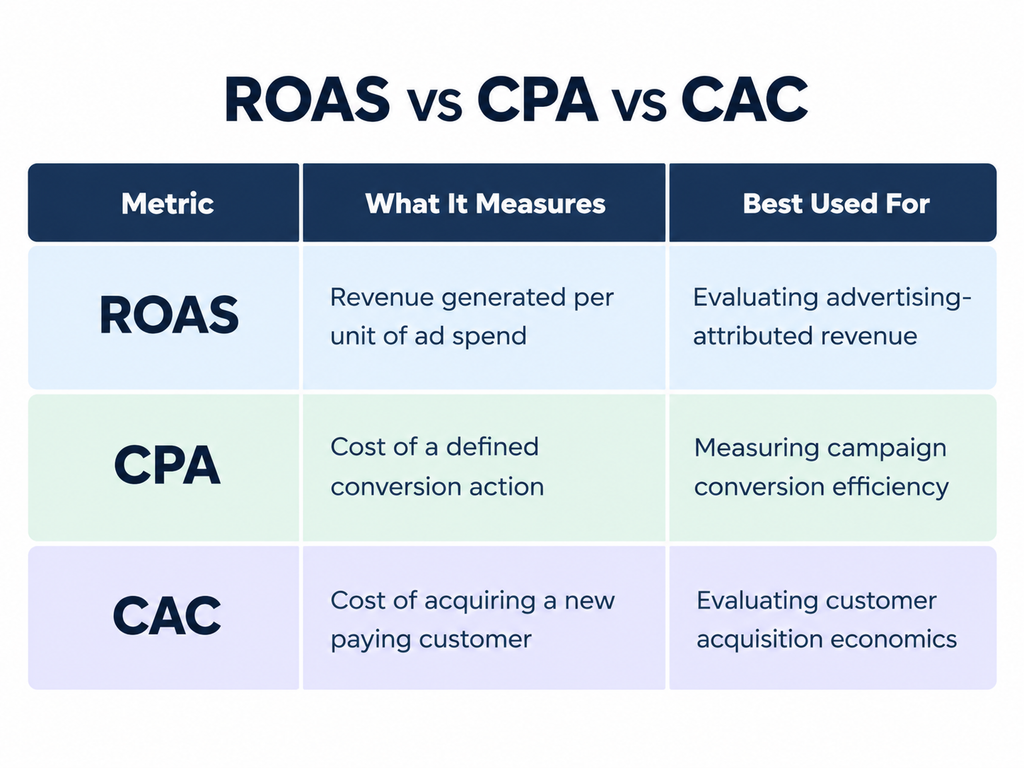
Consider a campaign that spends ₹20,000, generates ₹1,00,000 in attributed revenue, and produces 100 leads that eventually result in 10 new customers.
• ROAS = 5x
• Cost per lead = ₹200
• Advertising cost per new customer = ₹2,000
If the business also spends money on sales salaries, software, and agency fees, its fully calculated CAC will be higher than the advertising cost per customer.
These metrics complement one another. Looking at only one can hide important information about overall performance.
5. Which Metric Actually Matters Most?
There is no single metric that matters most for every business. The right choice depends on what you sell and what you want your marketing campaigns to achieve.
For E-commerce Businesses
ROAS is useful for evaluating advertising-attributed revenue, while CPA helps track purchase acquisition costs. Profit margins should also be considered before increasing spending.
For Lead Generation Businesses
CPA is useful for monitoring the cost of enquiries or leads. However, qualified lead cost and CAC provide a clearer picture of how effectively those enquiries turn into paying customers.
For SaaS and Subscription Businesses
CAC is especially important because acquiring a customer may involve multiple marketing and sales touchpoints. Comparing CAC with customer lifetime value and gross margin helps assess the sustainability of growth.
For Service-Based Businesses
CPA can measure enquiry generation, but CAC is often more useful for understanding the cost of winning a client. The value and profitability of each client should also influence acquisition decisions.
The most effective approach is to select a primary metric aligned with your business objective and use supporting metrics to understand the complete customer journey.
6. How to Use ROAS, CPA, and CAC Together
Tracking all three metrics gives you a more complete view of your marketing performance.
Follow these steps:
• Define the primary campaign objective, such as purchases, qualified leads, or new customers.
• Track CPA to understand the cost of generating the intended conversion.
• Measure ROAS when reliable advertising-attributed revenue data is available.
• Calculate CAC using your defined sales and marketing acquisition costs.
• Compare acquisition costs with gross profit and customer lifetime value.
• Review results over an appropriate period, especially when sales cycles are long.
For example, a campaign may generate leads at a low CPA but have a high CAC because few leads convert into customers. In this situation, improving lead qualification and sales follow-up may be more valuable than simply generating additional leads.
How Tagscripts Digital Marketing Agency Measures Campaign Performance
Effective performance marketing requires more than optimizing campaigns for clicks or inexpensive conversions. Businesses need to understand whether their advertising efforts contribute to qualified leads, revenue, and sustainable growth.
Tagscripts Digital Marketing Agency approaches campaign performance by connecting advertising objectives with meaningful business outcomes. This includes reviewing campaign data, evaluating conversion quality, identifying inefficient spending, and understanding how paid traffic contributes to enquiries and sales.
By examining the relationship between campaign costs, conversion performance, and business results, companies can make better-informed decisions about budget allocation and future growth opportunities.
The focus is on measuring what matters to the business rather than treating a single advertising metric as the complete picture.
Conclusion
ROAS, CPA, and CAC measure different aspects of marketing performance. ROAS shows the revenue generated relative to advertising spend, CPA measures the cost of a defined conversion, and CAC estimates the cost of acquiring a new paying customer.
Instead of choosing one metric and ignoring the others, use them together to understand advertising efficiency, conversion quality, and customer acquisition economics.
The most important metric is the one that aligns with your business goals while helping you make financially sound marketing decisions.
Want to understand which marketing metrics matter most for your business? Connect with Tagscripts Digital Marketing Agency to evaluate campaign performance and make more informed advertising decisions.
FAQs
1. What is the difference between ROAS and CAC?
ROAS measures advertising-attributed revenue relative to advertising spend, while CAC measures the cost of acquiring a new customer using the sales and marketing costs included in your calculation.
2. Is CPA the same as CAC?
No. CPA measures the cost of a defined conversion action, such as a lead or purchase. CAC measures the cost of acquiring a new paying customer and may include broader sales and marketing expenses.
3. What is a good ROAS for digital marketing?
A good ROAS depends on product margins, operating expenses, business objectives, and customer value. A high ROAS does not automatically guarantee profitability.
4. Why is CAC important for business growth?
CAC helps businesses understand the resources required to acquire customers and whether their acquisition model can support profitable, sustainable growth.
5. Which metric should I track in Google Ads?
Choose the metric that matches your campaign objective. Track CPA for defined conversion actions and ROAS for revenue-focused campaigns. Where possible, connect advertising data with qualified leads, actual sales, and customer acquisition costs.
